
Access all our platforms from a single account.

Asia Market Quick Take – 27 November, 2026

Key points:
- Macro: Trump unveils new global tariffs, weakening China+1 strategy
- Equities: Kioxia surges on reported Nvidia tie-up
- FX: Dollar firms in thin Thanksgiving trading as AI-led risk stabilizes
- Commodities: Oil climbs; WTI near $85, on track for first weekly gain this month
- Fixed income: No US cash Treasuries on Thanksgiving; UK, German yields inch higher
------------------------------------------------------------------
Disclaimer: Past performance does not indicate future performance.
Macro:
- The Trump administration announced a fresh round of tariffs on goods from China, the EU and approximately a dozen other economies, reviving sweeping global import taxes after the Supreme Court had previously found an earlier iteration unconstitutional. Japan protested the 15% levy on its exports, while Thailand described its 18% rate as competitive. Countries including Vietnam face rates approaching or exceeding those on Chinese goods, undermining the "China+1" supply chain strategy.
- Fed Chair Kevin Warsh faces a dilemma: market stress is intensifying calls for a policy pivot, but above-target inflation and resilient economic data argue for continued tightening.
- The US government is $511.1 billion away from the $41.1 trillion debt ceiling as of 24 November. Upcoming Treasury auctions include $95 billion in 3-month bills and $82 billion in 6-month bills on 30 November.
- The Bank of England's Financial Policy Committee proposed a 30 basis point reduction to UK lenders' capital requirements, while warning that further cuts would risk financial instability.
Equities:
- US — US cash markets were closed on Thursday for Thanksgiving. On Wednesday, the S&P 500 fell 0.5% and the Nasdaq 100 briefly entered bear market territory before a late-session dip-buying recovery. After the holiday close, S&P 500 futures rose 0.6%, Nasdaq 100 futures gained 0.6% and Dow futures rose 0.5%, with the 10-year Treasury yield at 4.854%. Best Buy rose 3.1% pre-market on Wednesday after a beat-and-raise quarter. HPE fell in pre-market trading despite an earnings beat, after management warned of a significantly supply-constrained environment for memory and NAND components.
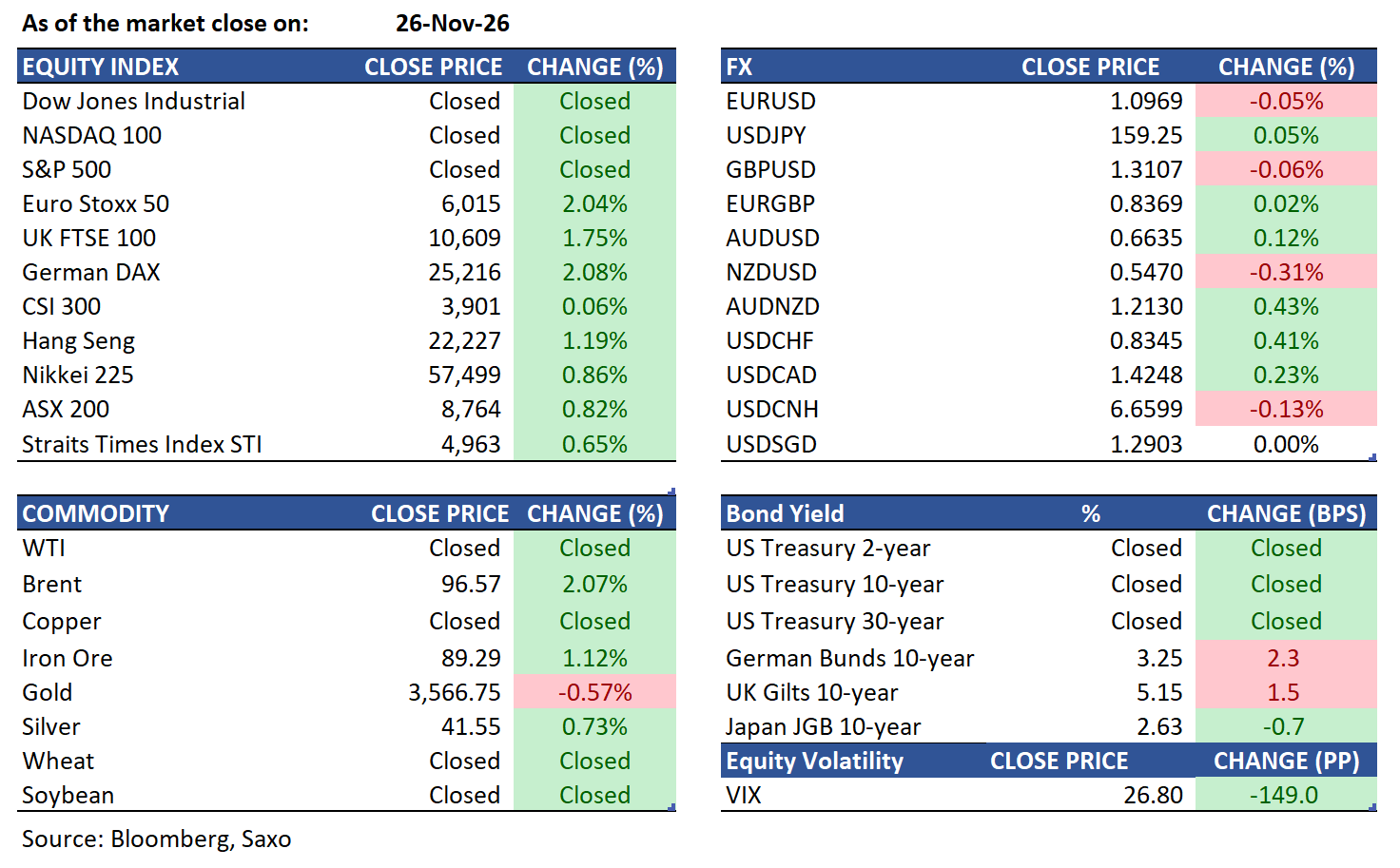
- EU — European equities rebounded strongly on Thursday, tracking Wednesday's late recovery on Wall Street. The Stoxx 600 rose 1.7%, the DAX gained 2.1% to 25,215, the FTSE 100 rose 1.8% to 10,609, the CAC 40 gained 1.6% to 8,109 and the Euro Stoxx 50 rose 2.0% to 6,015. Tech and semiconductor stocks led gains — ASML +3.2%, Infineon +4.0%, STMicro +4.3%. Volkswagen was the top DAX mover, up 4.6%. Imperial Brands surged on M&A speculation, helping lift the FTSE. Nokia rose 5.1% in the Nordic index.
- Asia — Asian equities extended their rebound on Friday, marking a second consecutive day of gains. The MSCI Asia Pacific gauge rose 0.6%. The Kospi opened up 0.4% to 4,728.80, supported by reports that South Korea is reviewing an expansion of its stock market stabilisation fund. Nikkei futures were firm, boosted by Kioxia's surge following a reported tie-up with Nvidia, though the stock has plunged more than 40% this month and now trades at the cheapest valuation in the Nikkei 225 at approximately 1.7x forward earnings. The Hang Seng Tech Index remains under pressure — down 38% year-to-date in its worst-ever annual performance — as China tech earnings missed already-conservative estimates. The Shanghai Composite is approaching the critical 3,400 support level; a break below would put it in a technical bear market. KKR is reportedly planning to withdraw its take-private proposal for Japan's Sankei Real Estate.
Earnings this week:
- Friday - Meituan
FX:
- USD was modestly stronger across most G10 FX on Thursday in thin holiday trading (US Thanksgiving), supported by stabilising risk sentiment after Wednesday’s AI-led equity rebound.
- CHF underperformed, falling around 0.4% against the USD as haven demand unwound on improved risk appetite and a rally in European equities, though options markets still price relatively rich EURCHF volatility and favour CHF gains against the EUR over the next month.
- NZD was the weakest G10 currency in early Asia (down over 1% at the 6pm Tokyo snapshot) before trimming losses, and AUD similarly underperformed as lingering risk-off sentiment weighed despite the equity bounce.
- USDJPY was steady near 159.25 in thin holiday trading; modest support came from BOJ board member Tamura’s call for further rate hikes, but yen appreciation faces a structural headwind as major Japanese life insurers have cut FX hedging on foreign assets to a record-low 43.3%.
- USDCAD edged up toward 1.4245, with the loonie slipping about 0.16% and ranking as the weakest on the late-day G10 scorecard, even as markets increasingly price a 25bp Bank of Canada hike in December—much of which may already be reflected after earlier hawkish remarks.
- EURUSD hovered around 1.0960 and remains technically bearish below its 21-day moving average, with technicians highlighting a weekly close above 1.0882 (the 61.8% retracement of gains since early 2025) as needed to signal that downside risks are easing.
Commodities:
- Gold steadied near $3,565 an ounce, on track for a modest weekly gain after a 15-month low amid choppy trading, as traders weighed potential Federal Reserve rate hikes against a broader recovery.
- Copper is on track for one of its worst monthly performances in more than a decade, down approximately 17% in November. Physical supply remains tight, with Chinese buyers still paying premiums for spot metal.
- Oil climbed on Friday after Houthi rebels struck a key Saudi refinery, with WTI trading near $85 per barrel and heading for its first weekly gain this month. Earlier in the week, Brent settled near $95 per barrel after Saudi forces intercepted drones targeting the Ras Tanura refinery and export facility.
Fixed income:
- With US markets closed Thursday for Thanksgiving, there was no cash Treasury trading, though futures held steady. Cash trading will be open in Asia and Europe on Friday, while the New York session will close early at 2 p.m. ET, according to the Securities Industry and Financial Markets Association.
- UK and German 10-year yields each rose 2 basis points on Thursday as the risk rebound reduced haven demand. Commerzbank is reportedly considering paring back its involvement in US Treasury trading, including a potential exit from the US repo market, ahead of new clearing requirements.
For a global look at markets – go to Inspiration.
This content is marketing content and should not be considered investment advice. Trading financial instruments carries risks and historic performance is not a guarantee for future performance.
The instrument(s) mentioned in this content may be issued by a partner, from which Saxo receives promotion, payment or retrocessions. While Saxo receives compensation from these partnerships, all content is conducted with the intention of providing clients with valuable options and information.